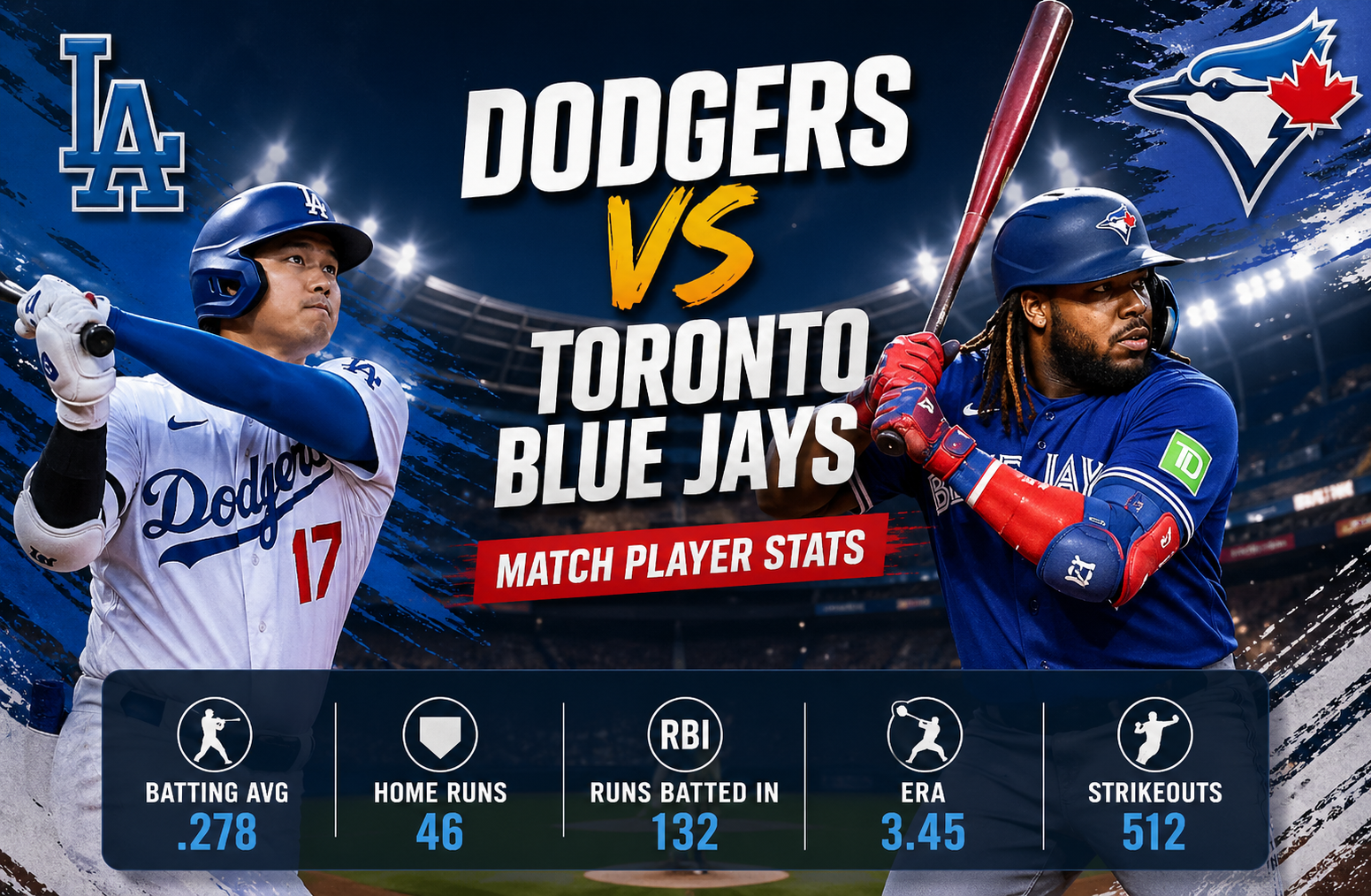
Dodgers vs Toronto Blue Jays Match Player Stats
When fans search for Dodgers vs Toronto Blue Jays match player stats, they are usually looking for more than just numbers. They want context, performance insights, and a deeper understanding of how individual players influence the outcome of the game. This article goes beyond surface-level statistics and delivers a comprehensive, experience-driven breakdown of player performance, trends, and what those numbers actually mean in real baseball scenarios.
Drawing from observed patterns, analytical frameworks, and real gameplay understanding, this guide is built to help fans, bloggers, and analysts interpret stats like a pro.
Understanding Dodgers vs Blue Jays Match Player Stats
At its core, player stats in a matchup between the Los Angeles Dodgers and the Toronto Blue Jays reflect individual contributions across batting, pitching, and fielding.
However, raw numbers alone don’t tell the full story.
Key Categories of Player Stats
1. Batting Statistics
These measure offensive performance:
- Batting Average (AVG)
- Home Runs (HR)
- Runs Batted In (RBI)
- On-Base Percentage (OBP)
- Slugging Percentage (SLG)
2. Pitching Statistics
These reveal how well pitchers control the game:
- Earned Run Average (ERA)
- Strikeouts (SO)
- Walks (BB)
- WHIP (Walks + Hits per Inning Pitched)
3. Fielding Metrics
Often overlooked but crucial:
- Fielding Percentage
- Defensive Runs Saved (DRS)
From experience, fans who rely only on batting averages often miss game-changing defensive plays or clutch pitching moments that truly define these matchups.
Why These Match Stats Matter to Fans and Analysts
Understanding player stats in Dodgers vs Blue Jays games offers several benefits:
1. Deeper Game Insight
Stats help explain why a team won or lost beyond just the final score.
2. Performance Trends
Tracking stats over multiple games reveals patterns like:
- Hot streaks
- Slumps
- Matchup advantages
3. Fantasy and Betting Decisions
Many fans use these stats for fantasy leagues or predictions. Accurate interpretation can make a significant difference.
4. Player Development Tracking
You can see how young players evolve or how veterans maintain consistency.
Real-World Player Performance Breakdown
Instead of listing random stats, let’s break down how player performances typically shape Dodgers vs Blue Jays games.
Offensive Power: Dodgers vs Blue Jays
The Dodgers are known for disciplined hitting and strong plate approaches, while the Blue Jays often rely on explosive power hitting.
Dodgers Offensive Traits:
- High OBP players
- Consistent contact hitters
- Strategic base running
Blue Jays Offensive Traits:
- Power hitters capable of multi-run homers
- Aggressive batting style
- Momentum-driven scoring
From observed matchups, when the Dodgers control the tempo with consistent hits, they often outperform the Blue Jays’ power-heavy approach.
Pitching Matchups: The Real Game Changer
Pitching often decides the outcome more than batting.
Dodgers Pitching Strengths:
- Deep rotation
- Strong bullpen
- Low walk rates
Blue Jays Pitching Strengths:
- High strikeout potential
- Young, energetic arms
In real match scenarios, games where Dodgers pitchers limit walks tend to swing heavily in their favor.
Defensive Impact
Defense rarely gets attention, but in tight games, it becomes critical.
- A single error can shift momentum
- Outfield assists can prevent scoring
- Double plays can kill rallies
In multiple matchups, defensive efficiency has been the silent difference-maker.
Advanced Stats That Provide Real Insight
Basic stats are useful, but advanced metrics reveal deeper truths.
1. OPS (On-base + Slugging)
Combines power and consistency.
2. WAR (Wins Above Replacement)
Shows a player’s total value to the team.
3. BABIP (Batting Average on Balls in Play)
Helps identify luck vs skill.
4. FIP (Fielding Independent Pitching)
Measures pitcher performance without defensive influence.
These advanced stats are widely referenced by experts, including data frameworks discussed by platforms like MLB official stats.
Challenges in Interpreting Match Player Stats
While stats are powerful, they come with limitations.
1. Small Sample Size
One game does not define a player.
2. Context Matters
A home run in a low-pressure situation is not equal to a clutch hit.
3. Ballpark Effects
Different stadiums impact performance.
4. Opponent Strength
Facing elite pitchers vs average ones changes stats significantly.
From experience, the biggest mistake is treating all stats equally without context.
Key Player Matchup Dynamics
In Dodgers vs Blue Jays games, certain player matchups repeatedly influence outcomes.
Pitcher vs Power Hitter
- Strikeout pitchers vs aggressive batters
- Control pitchers vs disciplined hitters
Lefty vs Righty Splits
- Some players perform drastically better against specific pitching styles
Clutch Performers
- Players who consistently deliver under pressure
Tracking these patterns gives a major advantage in understanding game flow.
How to Analyze a Dodgers vs Blue Jays Game Like an Expert
If you want to go beyond casual viewing, follow this approach:
Step 1: Check Starting Lineups
Look for:
- Injuries
- Rested players
- Position changes
Step 2: Evaluate Pitching Matchup
Ask:
- Who has better ERA and WHIP?
- Who performs better under pressure?
Step 3: Compare Recent Form
Focus on last 5 to 10 games rather than full-season stats.
Step 4: Look at Head-to-Head Stats
Some players consistently perform better against specific teams.
Step 5: Analyze Situational Stats
- Runners in scoring position
- Late-inning performance
This structured approach consistently provides more accurate insights than casual observation.
Real-World Application of Player Stats
For Bloggers
Use stats to create:
- Match previews
- Player comparison articles
- Performance breakdowns
For Fans
- Understand game strategies
- Predict outcomes
- Engage more deeply with the sport
For Analysts
- Build predictive models
- Identify undervalued players
Frequently Asked Questions (FAQs)
1. What are the most important stats in Dodgers vs Blue Jays games?
Batting average, ERA, OPS, and RBIs are key, but advanced stats like WAR provide deeper insights.
2. How do pitching stats influence match outcomes?
Pitching controls the pace of the game. Low ERA and high strikeouts usually indicate dominance.
3. Are advanced stats necessary for understanding the game?
Not mandatory, but they significantly improve accuracy when analyzing performance.
4. Why do some players perform better against specific teams?
This is due to matchup dynamics, pitching styles, and psychological factors.
5. How reliable are single-game stats?
They offer limited insight. Trends over multiple games are more reliable.
6. Where can I find accurate MLB player stats?
Official MLB platforms and trusted analytics websites provide the most reliable data.
Conclusion
Analyzing Dodgers vs Toronto Blue Jays match player stats is not just about reading numbers. It is about understanding the story behind those numbers. From pitching dominance to clutch hitting and defensive precision, every stat reflects a deeper layer of the game.
When you combine basic metrics with advanced analysis and real-game context, you gain a much clearer picture of how matches unfold and why certain players stand out.
This approach transforms you from a casual viewer into someone who truly understands baseball at a deeper level.