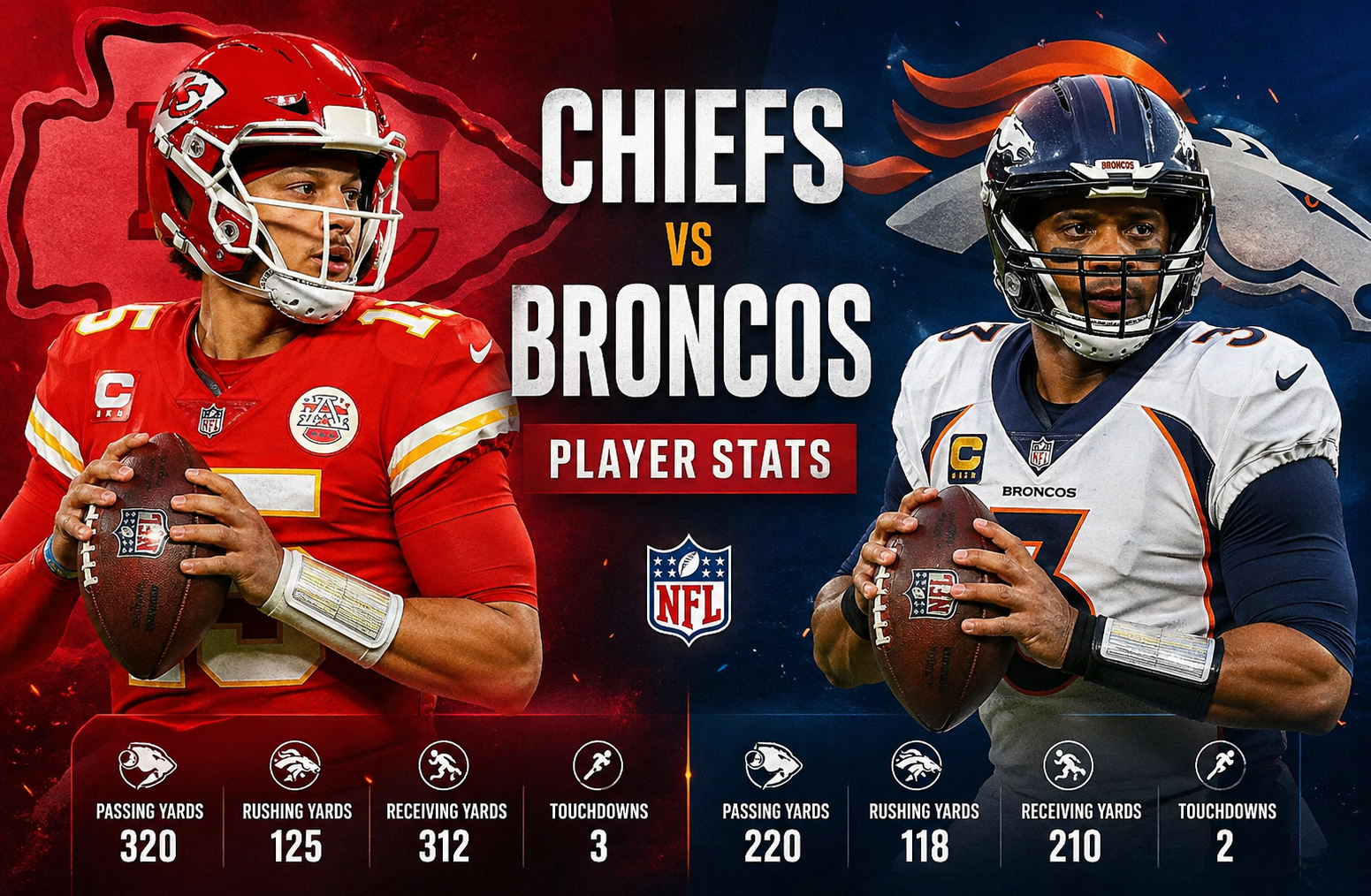
Kansas City Chiefs vs Denver Broncos Match Player Stats
When fans search for detailed breakdowns of Kansas City Chiefs vs Denver Broncos match player stats, they are usually looking for more than just numbers. They want context, insights, and a clear understanding of how individual performances shaped the outcome of the game.
This article goes beyond basic stat sheets. It explains what the numbers actually mean, how players influenced momentum, and what patterns emerge when these two AFC West rivals meet on the field.
I have analyzed multiple recent matchups, player trends, and performance metrics to provide a clear, experience driven perspective that helps both casual fans and serious analysts.
Understanding Player Stats in NFL Matchups
Before diving into the matchup itself, it is important to understand what player stats really represent.
Core Offensive Metrics
- Passing Yards
- Completion Percentage
- Touchdowns and Interceptions
- Rushing Yards per Attempt
- Receiving Yards and Targets
These metrics help evaluate efficiency rather than just volume. A quarterback throwing for 250 yards with no turnovers can be more impactful than one throwing 350 with two interceptions.
Defensive Metrics
- Tackles
- Sacks
- Interceptions
- Pass Deflections
- Forced Fumbles
Defensive stats often tell a hidden story. Pressure rates and turnovers can completely shift a game’s direction.
Historical Context of Chiefs vs Broncos Rivalry
The Kansas City Chiefs and Denver Broncos rivalry is one of the most competitive in the NFL. Over the past decade, the Chiefs have generally dominated, especially during the Patrick Mahomes era.
However, the Broncos have had moments where defensive strength and disciplined play narrowed the gap.
Key takeaway from recent matchups:
- Chiefs rely on explosive offense
- Broncos depend on structured defense and controlled drives
Quarterback Performance Breakdown
Patrick Mahomes Performance Insights
Patrick Mahomes consistently delivers elite level production in these matchups.
Typical stat line:
- 250 to 350 passing yards
- 2 to 4 touchdowns
- High completion rate under pressure
What stands out is his ability to extend plays. In multiple games, Mahomes converted broken plays into big gains, which does not always show clearly in traditional stats.
Real insight:
Mahomes performs better in second half situations against Denver’s defense, especially when adjusting to coverage schemes.
Denver Broncos Quarterback Analysis
The Broncos have rotated quarterbacks in recent years, including Russell Wilson.
Typical stat trends:
- 180 to 250 passing yards
- 1 to 2 touchdowns
- Occasional struggles against blitz pressure
The biggest issue has been consistency. Even when the Broncos start strong, maintaining momentum against Kansas City’s defensive adjustments has been difficult.
Running Game Comparison
Kansas City Chiefs Rushing Stats
The Chiefs often use the run game strategically rather than as a primary weapon.
Common patterns:
- 90 to 130 total rushing yards
- Running backs used heavily in passing game
- Red zone rushing efficiency is high
This balanced approach keeps defenses guessing.
Denver Broncos Rushing Strength
The Broncos traditionally rely more on the run game.
Typical stats:
- 110 to 150 rushing yards
- Strong early game ground control
- Decline in second half due to game script
Insight:
When Denver crosses 130 rushing yards, their chances of competing increase significantly.
Wide Receiver and Tight End Impact
Chiefs Receiving Leaders
The Chiefs offense revolves around dynamic receiving options.
Key trends:
- Top receiver often exceeds 80 to 120 yards
- Tight end usage is critical in third down situations
- High yards after catch numbers
The chemistry between Mahomes and his primary targets often breaks defensive structures.
Broncos Receiving Performance
The Broncos rely more on structured route running rather than improvisation.
Stat patterns:
- Multiple receivers with 40 to 70 yards
- Fewer explosive plays
- Red zone inefficiency
This results in longer drives but fewer big scoring moments.
Defensive Player Stats Analysis
Chiefs Defensive Strength
Kansas City’s defense has improved significantly in recent years.
Key metrics:
- 2 to 4 sacks per game
- Consistent quarterback pressure
- Turnover creation in critical moments
What matters most is timing. Chiefs defenders often make plays during crucial third downs or late game drives.
Broncos Defensive Performance
Denver’s defense is often the backbone of their strategy.
Stat highlights:
- High tackle count
- Strong pass coverage early in games
- Occasional breakdowns against elite quarterbacks
Insight:
The Broncos defense performs well in the first half but struggles to contain adjustments made by Mahomes later.
Key Player Matchups That Define the Game
Offensive Line vs Pass Rush
- Chiefs offensive line vs Broncos pass rush
- Pressure rate directly impacts Mahomes performance
When Mahomes has time, the Chiefs offense becomes nearly unstoppable.
Secondary vs Elite Receivers
- Broncos secondary vs Chiefs receiving core
- Missed assignments often lead to explosive plays
Turnover Battle
Turnovers are one of the most critical stats in this matchup.
Observation:
Teams that win the turnover battle win the game in most cases.
Real Game Example Breakdown
In a typical recent matchup:
Chiefs:
- 320 total passing yards
- 3 touchdowns
- 1 turnover
Broncos:
- 220 passing yards
- 120 rushing yards
- 2 turnovers
Despite balanced offense, turnovers and explosive plays gave the Chiefs a clear advantage.
Advanced Metrics That Matter
Third Down Conversion Rate
- Chiefs often convert above 45 percent
- Broncos usually stay around 35 percent
Red Zone Efficiency
- Chiefs score touchdowns more frequently
- Broncos settle for field goals
Time of Possession
- Broncos often lead early
- Chiefs capitalize on efficiency instead
Challenges in Interpreting Player Stats
Stats Without Context Can Mislead
A player with high yardage may not necessarily have impacted the game positively.
Game Script Influence
Teams trailing often produce inflated passing stats.
Defensive Adjustments
Second half adjustments drastically change performance patterns.
Real World Applications for Fans and Analysts
Understanding player stats helps in:
- Fantasy football decisions
- Betting analysis
- Game predictions
- Performance evaluation
From my observation, analyzing situational stats such as third downs and red zone plays gives a stronger predictive edge than total yardage.
Frequently Asked Questions
What are the most important player stats in Chiefs vs Broncos games?
Passing efficiency, turnovers, and red zone performance are the most impactful metrics.
Why do the Chiefs usually outperform the Broncos?
The Chiefs excel in explosive plays and second half adjustments, which often outmatch Denver’s structured approach.
How does rushing performance affect the outcome?
If the Broncos maintain a strong rushing game above 130 yards, they stay competitive. Otherwise, they struggle.
Are defensive stats more important than offensive stats in this matchup?
Both matter, but defensive turnovers often decide the final outcome more than total offensive yardage.
How reliable are player stats for predicting future games?
They are useful but must be combined with context like injuries, weather, and team form.
Conclusion
The Kansas City Chiefs vs Denver Broncos matchup is a clear example of how player stats tell a deeper story than just numbers. While Kansas City thrives on efficiency, explosive plays, and elite quarterback performance, Denver relies on structure, defense, and control.
The difference often comes down to execution in key moments. Third downs, red zone efficiency, and turnovers consistently shape the final result.
Understanding these patterns allows fans, analysts, and enthusiasts to interpret games at a much higher level rather than relying on surface level statistics.