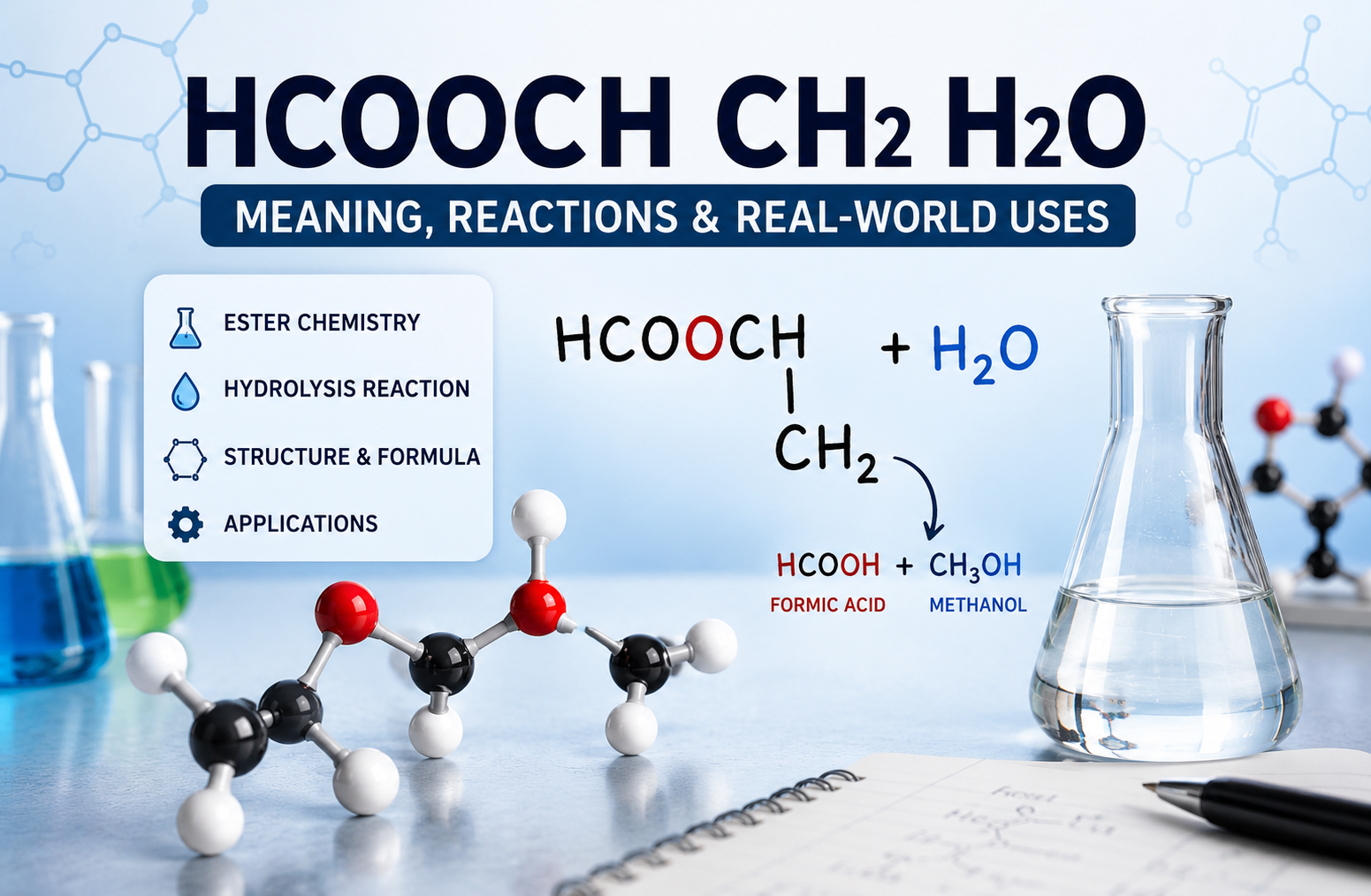
Hcooch Ch2 H2o Explained Simply
Chemistry often looks complicated because many compounds are written in symbolic form instead of plain language. One expression that creates confusion for students, researchers, and curious readers is hcooch ch2 h2o. At first glance, it may appear to be a random chemical combination, but understanding its structure, behavior, and possible interpretation opens the door to important concepts in organic chemistry and molecular reactions.
The term hcooch ch2 h2o is commonly associated with discussions around organic compounds, hydrolysis reactions, ester chemistry, and molecular transformation in laboratory studies. People searching for this topic usually want to know what the formula means, whether it represents a real compound, how it behaves chemically, and where it may be used in scientific applications.
This guide explains the topic in a clear and practical way without unnecessary technical complexity. Instead of repeating textbook definitions, the article focuses on real understanding, chemical context, and practical relevance so readers can confidently interpret the formula and its significance.
What Does Hcooch Ch2 H2o Mean?
The expression hcooch ch2 h2o appears to combine multiple chemical fragments rather than representing one standard molecular formula. To understand it properly, it helps to break the expression into smaller parts.
1. HCOOCH
This portion resembles part of an ester structure. Esters are organic compounds formed when an acid reacts with an alcohol. They are widely used in:
- Fragrances
- Industrial solvents
- Flavoring agents
- Pharmaceutical manufacturing
- Polymer production
The “HCOO” section is often associated with a formate group derived from formic acid.
2. CH2
CH2 refers to a methylene group, a basic structural unit found in countless organic molecules. It acts as a connecting bridge between atoms inside larger compounds.
3. H2O
H2O is water, one of the most important molecules in chemistry. Water participates in hydrolysis, hydration, dissolution, temperature regulation, and biological reactions.
When these components appear together, the expression may refer to a reaction environment, structural shorthand, or an incomplete notation used in educational material.
Why This Chemical Expression Creates Confusion
One reason many people search for this phrase is because it does not follow a universally accepted naming format. In chemistry, small formatting differences can completely change a molecule’s meaning.
From an educational perspective, the phrase may represent:
- A simplified reaction pathway
- A shorthand laboratory notation
- An ester hydrolysis example
- A partial structural representation
- A miswritten molecular formula from online sources
In many online discussions, formulas become distorted due to formatting issues, missing subscripts, or incorrect spacing. That is why understanding the underlying chemistry matters more than memorizing symbols alone.
Organic Chemistry Context Behind the Formula
To understand the scientific relevance of this expression, it is helpful to explore ester chemistry and water driven reactions.
Esters and Hydrolysis
Esters react with water through a process called hydrolysis. During this reaction:
- Water molecules break chemical bonds
- The ester separates into alcohol and acid components
- New molecular products form
This type of reaction is extremely important in:
- Drug metabolism
- Food chemistry
- Biochemistry
- Industrial manufacturing
- Environmental degradation studies
A simplified reaction may look like this:
Ester + Water → Alcohol + Acid
The inclusion of H2O in the expression strongly suggests water participation in a reaction process rather than simple molecular listing.
The Role of Water in Chemical Transformations
Water is not just a solvent. In many reactions, it acts directly as a reactant.
Important Functions of Water in Organic Chemistry
| Function | Explanation |
| Hydrolysis | Breaks larger molecules into smaller ones |
| Solvent Action | Dissolves ionic and polar substances |
| Temperature Stability | Controls reaction heat |
| Proton Transfer | Supports acid base chemistry |
| Molecular Interaction | Helps stabilize intermediates |
In reactions involving esters, water often determines how quickly decomposition or transformation occurs.
Possible Interpretation as Methyl Formate Chemistry
Some chemists interpret the formula as related to methyl formate or similar formate esters.
What Is Methyl Formate?
Methyl formate is an organic ester with industrial and laboratory relevance. It is used in:
- Manufacturing
- Chemical synthesis
- Solvent production
- Agricultural chemistry
- Intermediate reactions
It has a recognizable fruity odor and participates in several controlled chemical reactions.
Hydrolysis of Formate Esters
When exposed to water under suitable conditions, formate esters can hydrolyze into:
- Formic acid
- Alcohol compounds
This interpretation aligns with the inclusion of H2O in the expression.
Real World Applications of Related Chemistry
Even if the exact notation is incomplete, the chemistry behind the expression has genuine industrial and scientific importance.
1. Pharmaceutical Development
Ester chemistry is heavily used in medicine manufacturing because esters can:
- Improve drug absorption
- Control release timing
- Increase stability
- Reduce bitterness in oral medicines
Many medications rely on controlled hydrolysis inside the human body.
2. Food and Flavor Industry
Organic esters are responsible for many fruit like aromas.
Examples include:
- Banana scents
- Apple flavor compounds
- Pineapple fragrance molecules
These compounds are carefully synthesized and tested in food science laboratories.
3. Polymer Manufacturing
Modern plastics and synthetic fibers often involve ester reactions during production.
Industries use these reactions to create:
- Polyester materials
- Coatings
- Adhesives
- Protective films
4. Agricultural Chemistry
Several pesticides and plant treatment chemicals contain ester based structures because they can degrade in controlled environmental conditions.
Why Students Frequently Search This Formula
Students commonly encounter chemical shorthand in:
- Lecture slides
- PDF notes
- Handwritten assignments
- Laboratory manuals
- Online chemistry forums
A formula written quickly by a teacher or copied incorrectly online may become difficult to interpret later. This often leads learners to search exact strings like hcooch ch2 h2o to identify the intended compound or reaction.
Understanding Molecular Structure Basics
To interpret chemical expressions more confidently, it helps to understand how molecular structures work.
Atoms and Bonds
Organic molecules are built from atoms connected through chemical bonds.
Common atoms include:
- Carbon
- Hydrogen
- Oxygen
- Nitrogen
Carbon acts as the backbone of most organic compounds because it forms stable chains and rings.
Structural Groups Matter
Instead of viewing formulas as random letters, chemists recognize patterns called functional groups.
Examples include:
| Functional Group | Example |
| Alcohol | OH |
| Ester | COO |
| Aldehyde | CHO |
| Carboxylic Acid | COOH |
The “HCOO” portion strongly resembles an ester or formate related group.
Chemical Reactions Associated With Ester Compounds
Acidic Hydrolysis
Acidic hydrolysis uses acid catalysts to break esters apart.
Characteristics include:
- Slow controlled reaction
- Water participation
- Reversible process
- Heat dependency
Basic Hydrolysis
Also called saponification.
Common in:
- Soap production
- Industrial cleaning chemistry
- Fat breakdown reactions
Unlike acidic hydrolysis, this reaction often proceeds more completely.
Safety Considerations in Organic Chemistry
Many ester compounds are safe under controlled conditions, but laboratory handling still requires caution.
Important Safety Practices
- Use protective eyewear
- Avoid inhaling vapors
- Maintain ventilation
- Store chemicals correctly
- Follow laboratory instructions carefully
Organic solvents can sometimes be flammable or irritating to skin and eyes.
For laboratory safety standards, the OSHA laboratory safety guidelines provide reliable professional guidance.
Common Misconceptions About Chemical Formulas
Misconception 1: Every Formula Represents a Single Compound
Not always true. Some notations describe reactions or molecular fragments.
Misconception 2: More Complex Looking Formulas Mean Dangerous Chemicals
Complex notation does not automatically indicate hazard level.
Misconception 3: Memorization Is Enough
Real chemistry understanding comes from recognizing patterns and reactions rather than memorizing symbols alone.
How Chemists Identify Unknown Compounds
If a scientist encounters an unclear formula, several techniques help identify the actual compound.
Spectroscopy
Methods include:
- Infrared spectroscopy
- NMR spectroscopy
- UV spectroscopy
These reveal molecular structure information.
Chromatography
Used to separate chemical mixtures for analysis.
Mass Spectrometry
Determines molecular weight and fragmentation patterns.
These tools help confirm whether a written formula matches a real chemical compound.
Educational Importance of Learning Chemical Notation
Understanding chemical notation builds foundational scientific literacy.
Students who learn structural interpretation gain advantages in:
- Organic chemistry
- Biochemistry
- Pharmacology
- Environmental science
- Materials engineering
Instead of fearing formulas, learners begin recognizing them as structured scientific language.
Relationship Between Organic Chemistry and Biology
Many biological systems rely on ester reactions and water mediated molecular changes.
Biological Examples
- Digestion of fats
- Energy metabolism
- DNA related chemistry
- Cellular signaling
- Enzyme activity
Hydrolysis reactions are especially important inside living organisms.
Challenges in Understanding Organic Chemistry
Organic chemistry is often considered difficult because:
- Molecules appear abstract
- Reactions involve multiple steps
- Structural drawings require practice
- Small changes alter outcomes dramatically
However, learning through pattern recognition makes the subject more approachable.
Practical Learning Tips for Students
Focus on Functional Groups
Recognizing recurring molecular patterns simplifies interpretation.
Learn Reaction Families
Instead of memorizing isolated reactions, group them by behavior.
Practice Structural Drawing
Visual learning improves retention significantly.
Use Reliable Scientific Sources
Avoid depending entirely on random online formula lists.
The Digital Spread of Incorrect Chemical Information
One growing problem online is the rapid spread of incorrectly formatted chemical expressions.
Causes include:
- OCR conversion errors
- Copy paste mistakes
- AI generated inaccuracies
- Missing subscripts
- Formatting limitations
Readers should always cross check unclear formulas with reputable chemistry databases or academic references.
Why Context Matters More Than Memorization
Professional chemists rarely interpret formulas in isolation. They examine:
- Reaction conditions
- Molecular environment
- Associated compounds
- Laboratory context
- Experimental purpose
The phrase becomes meaningful only when connected to surrounding chemistry.
Industrial Relevance of Ester Hydrolysis
Hydrolysis reactions affect product quality across many industries.
Manufacturing Impact
Industries monitor hydrolysis because it influences:
- Shelf life
- Stability
- Product purity
- Environmental breakdown
- Chemical efficiency
Understanding water driven reactions helps companies design more stable products.
Environmental Importance
Many organic compounds eventually interact with water in soil, rivers, and atmosphere.
Hydrolysis helps determine:
- Environmental persistence
- Toxicity duration
- Degradation speed
- Ecological impact
Environmental chemists carefully study these processes during safety assessments.
Scientific Curiosity and Online Searches
Searches for unusual formulas often reflect genuine curiosity. People want practical understanding rather than overly technical explanations.
The popularity of searches related to hcooch ch2 h2o highlights a broader trend:
- More students learning independently
- Greater interest in chemistry online
- Increased use of digital educational resources
- Growing curiosity about molecular science
How AI and Search Engines Affect Chemistry Learning
Modern search engines sometimes surface low quality chemistry explanations that:
- Mislabel compounds
- Ignore scientific context
- Repeat inaccurate interpretations
- Over simplify reactions
Helpful educational content should instead:
- Explain uncertainty honestly
- Clarify possible interpretations
- Use proper scientific reasoning
- Avoid fake precision
That approach aligns with modern quality standards for educational publishing.
The Importance of Accurate Chemical Communication
Clear scientific communication matters because misunderstanding formulas can lead to:
- Laboratory errors
- Incorrect calculations
- Safety risks
- Academic confusion
Scientists use standardized naming systems to reduce ambiguity.
Common Naming Standards
| System | Purpose |
| IUPAC Naming | International naming consistency |
| Molecular Formula | Atom counts |
| Structural Formula | Bond arrangement |
| Condensed Formula | Simplified representation |
Could the Formula Represent a Reaction Instead of a Compound?
Yes, that is highly possible.
The inclusion of water strongly suggests reaction involvement rather than a standalone molecule.
Possible educational interpretations include:
- Ester hydrolysis pathway
- Intermediate reaction notation
- Simplified reaction example
- Condensed classroom shorthand
Without additional context, assigning one exact compound would be scientifically unreliable.
Chemistry Learning in Modern Education
Chemistry education has evolved significantly.
Students now learn through:
- Interactive simulations
- Digital molecular modeling
- Video demonstrations
- Virtual laboratories
- AI assisted tutoring
However, foundational understanding still depends on mastering chemical notation and reaction logic.
Frequently Asked Questions
What does hcooch ch2 h2o mean in chemistry?
It appears to represent a combination of chemical fragments related to ester chemistry and water involved reactions rather than one universally recognized compound.
Is hcooch ch2 h2o a real chemical formula?
The notation does not match a standard IUPAC molecular formula exactly. It may be shorthand, an incomplete structure, or a reaction representation.
Why is water included in the expression?
Water often participates in hydrolysis reactions where esters break into smaller molecules.
What field of chemistry studies these compounds?
Organic chemistry primarily studies ester compounds, hydrolysis reactions, and related molecular transformations.
Are ester reactions important in real life?
Yes. Ester reactions are widely used in pharmaceuticals, food science, plastics, fragrances, and industrial manufacturing.
How can students better understand chemical formulas?
Learning functional groups, reaction patterns, and structural notation helps students interpret formulas more accurately.
Conclusion
Understanding hcooch ch2 h2o requires more than simply reading letters and numbers. The expression likely represents a chemistry concept connected to ester structures, hydrolysis reactions, or shorthand scientific notation rather than a single clearly defined compound.
The deeper lesson is that chemistry works through relationships between molecules, reactions, and context. Water driven reactions, ester transformations, and structural groups all play essential roles in pharmaceuticals, environmental science, food chemistry, and industrial production.
Readers who focus on understanding patterns instead of memorizing isolated formulas usually develop stronger scientific reasoning skills. Even unusual or unclear notations become easier to interpret once the foundational chemistry principles are understood clearly.