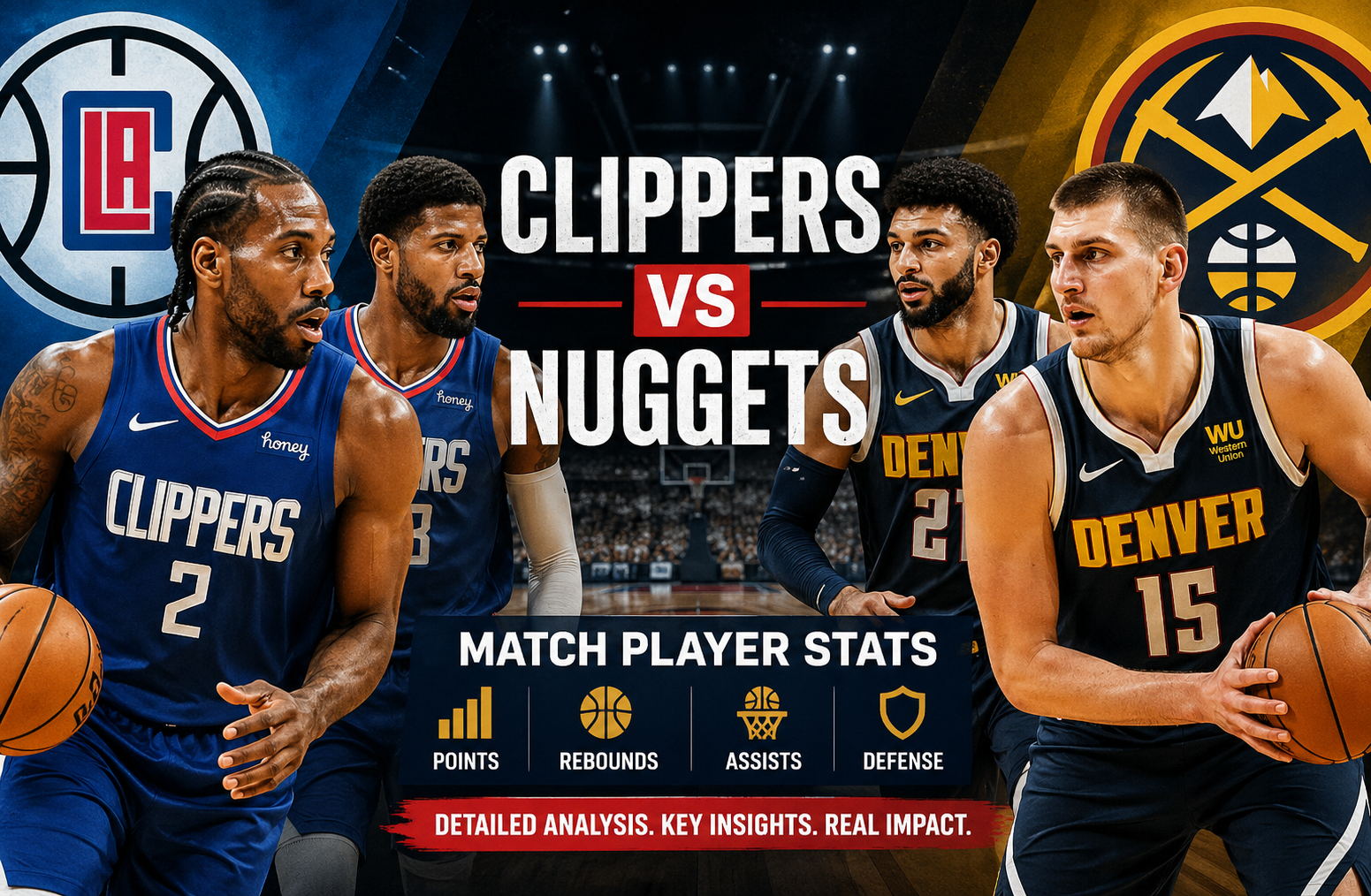
Clippers vs Denver Nuggets Match Player Stats
When fans search for Clippers vs Denver Nuggets match player stats, they are not just chasing box scores. They are looking for deeper meaning behind the numbers, context around performances, and insights that explain how individual contributions shape the outcome of a game.
Having followed NBA matchups closely over the years, this particular clash consistently stands out. It is a meeting of contrasting styles. One side often leans on structured offensive systems and elite passing, while the other thrives on isolation scoring, defensive versatility, and depth.
This article goes far beyond surface-level statistics. It breaks down player performances, highlights patterns that casual viewers often miss, and explains what these numbers actually mean in real-game situations.
Understanding Clippers vs Denver Nuggets Match Player Stats
What These Stats Actually Represent
At first glance, stats like points, rebounds, and assists seem straightforward. But in a matchup like this, numbers carry layered meaning.
Key statistical categories include:
- Scoring efficiency such as field goal percentage and true shooting percentage
- Playmaking impact through assists and turnover ratios
- Defensive contributions like steals, blocks, and contested shots
- Advanced metrics such as player efficiency rating and plus-minus
From experience, one mistake many readers make is focusing only on points scored. In reality, a player with fewer points but higher efficiency and defensive impact may have contributed far more to the game.
Team Dynamics and Playing Styles
Denver Nuggets: System-Driven Excellence
The Nuggets typically rely on:
- Ball movement and spacing
- High basketball IQ decision-making
- A central playmaking hub in the frontcourt
Their offensive system is built around creating high-percentage shots rather than forcing individual brilliance.
LA Clippers: Isolation and Defensive Flexibility
The Clippers often emphasize:
- Individual shot creation
- Mid-range scoring efficiency
- Strong perimeter defense
They are one of the few teams capable of switching defensive schemes without losing structure.
Key Player Performances Breakdown
Denver Nuggets Standout Performers
Nikola Jokic Impact Analysis
Nikola Jokic consistently produces stat lines that go beyond traditional expectations for a center.
Typical contributions include:
- Points in the mid to high 20s
- Double-digit rebounds
- High assist numbers for a big man
What stands out from experience is his decision-making. Jokic rarely forces plays. His assist numbers reflect real-time reading of defensive setups rather than pre-planned passes.
Advanced Insight:
- His true shooting percentage often exceeds league averages
- His plus-minus typically reflects strong on-court influence
- Turnover rates remain surprisingly low given his usage
Jamal Murray Scoring and Playmaking
Jamal Murray plays a critical role as a secondary creator.
Key statistical patterns:
- Efficient perimeter shooting
- Clutch scoring in high-pressure moments
- Balanced assist-to-turnover ratio
In high-stakes games, Murray’s performance often determines whether Denver maintains offensive flow or stagnates.
LA Clippers Standout Performers
Kawhi Leonard Efficiency and Defense
Kawhi Leonard is one of the most efficient two-way players in the league.
Typical stat contributions:
- 25 plus points with high efficiency
- Strong defensive metrics including steals
- Minimal wasted possessions
From observation, Kawhi’s impact is often understated in raw stats. His defensive positioning disrupts plays that never show up in the box score.
Paul George All-Around Contribution
Paul George provides versatility that few players can match.
Key statistical contributions:
- Scoring across all three levels
- Playmaking in transition
- Defensive pressure on opposing guards
His ability to contribute in multiple categories makes him a critical factor in balancing the Clippers’ offense.
Head-to-Head Statistical Comparison
Scoring Efficiency
When comparing both teams:
- Nuggets tend to have higher team field goal percentage
- Clippers often rely on mid-range efficiency
The difference lies in shot selection. Denver prioritizes high-percentage looks, while the Clippers trust individual shot-making ability.
Rebounding Battle
Rebounding often becomes a decisive factor.
- Nuggets typically dominate defensive rebounds
- Clippers focus more on limiting second-chance opportunities
Jokic’s positioning and anticipation give Denver a consistent edge here.
Assist and Ball Movement
Denver usually leads in assists due to their system-based offense.
- Higher assist totals reflect better ball movement
- Clippers may have fewer assists but higher isolation efficiency
This contrast highlights two different philosophies rather than one being better than the other.
Advanced Metrics That Tell the Real Story
Player Efficiency Rating
This metric combines multiple statistical categories into a single value.
Observations:
- Jokic often ranks among the highest
- Kawhi maintains elite efficiency with fewer wasted possessions
Plus-Minus Impact
Plus-minus shows how a team performs while a player is on the court.
Key takeaway:
- High plus-minus often correlates with strong defensive impact
- It also reflects lineup chemistry rather than individual skill alone
True Shooting Percentage
This metric accounts for:
- Field goals
- Three-point shots
- Free throws
It provides a more accurate picture of scoring efficiency than traditional percentages.
For a deeper understanding of advanced basketball analytics, you can refer to this resource from Basketball Reference, which explains statistical terms in detail.
Game-Changing Moments and Hidden Contributions
Role Players Who Shift Momentum
While star players dominate headlines, role players often decide outcomes.
Examples of impactful contributions:
- Bench scoring bursts
- Defensive stops in critical moments
- Hustle plays like offensive rebounds
From experience watching these matchups, a bench player scoring 10 quick points can swing momentum more than a star scoring 30 over the entire game.
Defensive Adjustments
Both teams make in-game adjustments:
- Clippers may switch to aggressive perimeter defense
- Nuggets may increase ball movement to counter pressure
These adjustments are rarely reflected directly in stats but influence them indirectly.
Challenges in Interpreting Player Stats
Misleading Raw Numbers
One of the biggest challenges is misinterpreting stats without context.
For example:
- A player scoring 30 points on low efficiency may hurt the team
- A player with fewer points but high efficiency may contribute more
Pace of Play
The pace at which a game is played affects stats:
- Faster games inflate scoring numbers
- Slower games emphasize efficiency
Defensive Matchups
Individual defensive assignments can impact performance:
- A strong defender can limit scoring opportunities
- This may lower stats without reflecting effort or skill
Real-World Application of These Stats
For Fans
Understanding player stats enhances viewing experience:
- You notice off-ball movement
- You appreciate defensive contributions
- You understand coaching strategies
For Analysts and Bloggers
Detailed stat analysis helps in:
- Writing in-depth game breakdowns
- Predicting future performance trends
- Providing unique insights beyond box scores
For Fantasy Basketball Players
Player stats directly impact fantasy outcomes:
- Efficiency metrics help in selecting players
- Consistency is often more valuable than occasional high scoring
Actionable Insights for Better Analysis
If you want to analyze games like a professional:
- Focus on efficiency, not just scoring
- Compare stats relative to minutes played
- Watch how players perform under defensive pressure
- Use advanced metrics alongside traditional stats
- Consider team strategy when evaluating individual performance
Frequently Asked Questions
What are the most important stats in Clippers vs Nuggets games?
The most important stats include scoring efficiency, assists, rebounds, and defensive metrics. Advanced stats like true shooting percentage provide deeper insight.
Who usually performs better in these matchups?
Performance varies by game, but key players like Nikola Jokic, Kawhi Leonard, and Jamal Murray often have the biggest impact.
Why are advanced stats important?
Advanced stats provide context that traditional stats miss. They help evaluate efficiency, impact, and overall contribution.
How does team strategy affect player stats?
Team strategy determines shot selection, ball movement, and defensive roles, all of which influence individual statistics.
Are bench players important in these games?
Yes, bench players often provide momentum shifts through scoring and defense, which can decide the outcome.
Conclusion
Clippers vs Denver Nuggets match player stats reveal much more than basic numbers. They tell the story of strategy, efficiency, and execution. While star players dominate attention, the true outcome often depends on subtle factors like defensive adjustments, role player contributions, and team chemistry.
Understanding these elements transforms how you watch and analyze games. Instead of focusing only on points scored, you begin to see the deeper layers that define winning basketball.