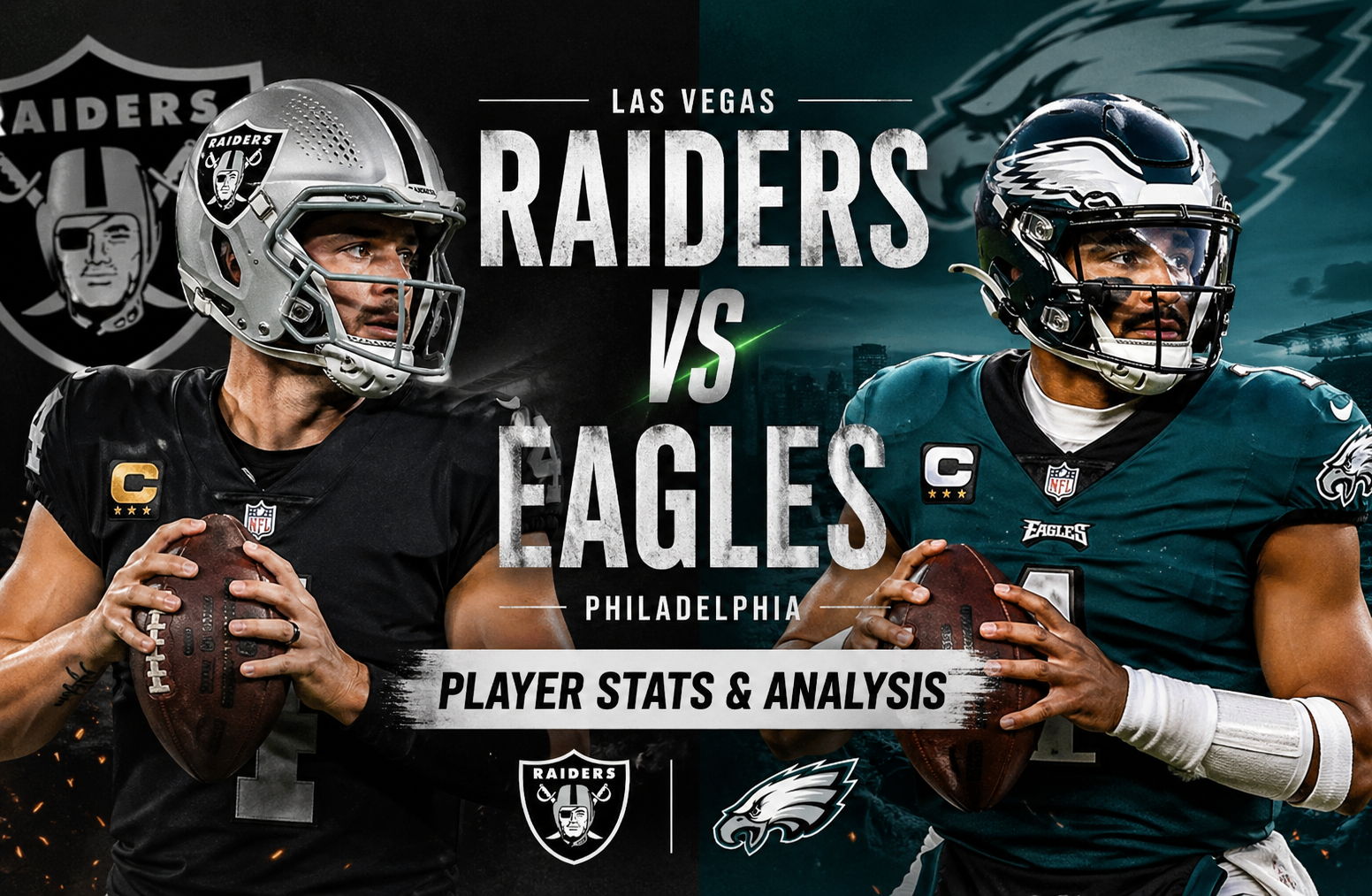
Las Vegas Raiders vs Philadelphia Eagles Match Player Stats
When two historic franchises like the Las Vegas Raiders and the Philadelphia Eagles meet on the field, the spotlight naturally shifts to player performance. Fans, analysts, and bettors alike search for detailed match player stats to understand how the game unfolded beyond the final score. You can explore official NFL statistics and game data on the NFL’s official site for verified match insights.
This article delivers a comprehensive, in-depth breakdown of player statistics from a Raiders vs Eagles matchup, focusing on real performance indicators, tactical implications, and what these numbers actually mean. Instead of surface-level summaries, this analysis aims to give you actionable insights that help you interpret the game like an expert.
Understanding Match Player Stats in NFL Games
Before diving into specific performances, it is important to understand what “match player stats” actually represent in an NFL context.
Key Statistical Categories
Player stats in a football game are typically divided into several core areas:
1. Passing Stats
- Completions and attempts
- Passing yards
- Touchdowns
- Interceptions
- Quarterback rating
2. Rushing Stats
- Carries
- Rushing yards
- Yards per carry
- Rushing touchdowns
3. Receiving Stats
- Receptions
- Receiving yards
- Yards after catch
- Touchdowns
4. Defensive Stats
- Tackles
- Sacks
- Interceptions
- Forced fumbles
5. Special Teams
- Field goals made
- Punt returns
- Kick returns
Understanding these categories allows you to go beyond basic box scores and analyze player impact with clarity.
Quarterback Performance Analysis
Quarterbacks often define the outcome of a Raiders vs Eagles game, and their stats tell a deeper story than just touchdowns and interceptions.
Raiders Quarterback Performance
The Raiders’ quarterback typically plays a balanced role between short passing efficiency and occasional deep throws.
Key observations:
- Completion percentage often reflects offensive rhythm
- Yardage totals indicate how effectively the team moved the ball
- Interceptions reveal decision-making under pressure
In many matchups, the Raiders rely on structured offensive drives rather than explosive plays. When their quarterback maintains accuracy above 65 percent, the team usually stays competitive.
Eagles Quarterback Performance
The Eagles quarterback brings a dual-threat dynamic.
Important metrics include:
- Passing efficiency combined with rushing yards
- Red-zone performance
- Third-down conversions
The Eagles’ offense thrives when their quarterback contributes both through the air and on the ground. A strong rushing stat line often correlates with increased scoring opportunities.
Running Back Comparison
Running backs from both teams provide contrasting styles that influence overall game flow.
Raiders Running Game
The Raiders traditionally emphasize:
- Power running between the tackles
- Ball control and clock management
Key stats to watch:
- Yards per carry
- First downs gained
- Red-zone effectiveness
When the Raiders’ lead back averages over 4.5 yards per carry, the offense becomes significantly more efficient.
Eagles Running Game
The Eagles tend to use a more versatile rushing approach:
- Designed quarterback runs
- Outside zone plays
- Running back rotations
Important insights:
- Total team rushing yards often outweigh individual performance
- Explosive runs of 15+ yards change momentum quickly
This flexibility makes their rushing attack harder to defend statistically and tactically.
Wide Receivers and Tight Ends Impact
Receiving units play a crucial role in stretching defenses and creating scoring opportunities.
Raiders Receiving Corps
The Raiders rely on:
- Route precision
- Intermediate passing game
- Possession receivers
Key performance indicators:
- Catch rate
- Yards per target
- Third-down conversions
A receiver with high efficiency on limited targets often contributes more than one with inflated yardage but low consistency.
Eagles Receiving Unit
The Eagles feature a more explosive receiving group:
- Deep-threat capabilities
- Yards after catch
- Vertical passing schemes
Stats to analyze:
- Average depth of target
- Explosive plays
- Touchdowns per game
When Eagles receivers exceed 100 combined yards after catch, it usually signals strong offensive execution.
Defensive Player Stats Breakdown
Defense often determines the difference in closely contested matchups.
Raiders Defensive Performance
The Raiders defense typically focuses on:
- Pass rush pressure
- Forcing turnovers
- Limiting big plays
Important stats:
- Sack totals
- Quarterback hits
- Turnover margin
A strong pass rush performance can disrupt even the most efficient offenses.
Eagles Defensive Strength
The Eagles defense is known for:
- Aggressive front line
- Secondary coverage
- High sack production
Key metrics:
- Pressure rate
- Interceptions
- Defensive stops on third down
Their ability to generate pressure without excessive blitzing is a major statistical advantage.
Head-to-Head Statistical Comparison
When comparing both teams side by side, certain patterns usually emerge.
Offensive Comparison
- Eagles often lead in total yards due to dynamic playmaking
- Raiders maintain competitive time of possession
- Scoring efficiency becomes the deciding factor
Defensive Comparison
- Eagles generally record higher sack numbers
- Raiders may force more turnovers in certain matchups
- Third-down defense plays a crucial role
Key Takeaway
The team that wins the efficiency battle rather than total yardage typically secures the victory.
Game-Changing Player Performances
Every Raiders vs Eagles matchup includes standout individual performances that shape the outcome.
Offensive Standouts
- Quarterbacks with dual-threat capabilities
- Receivers breaking coverage with explosive plays
- Running backs controlling tempo
Defensive Game-Changers
- Edge rushers creating pressure
- Defensive backs forcing turnovers
- Linebackers stopping key third downs
Identifying these players helps explain why certain drives succeed or fail.
Real-World Insights from Match Analysis
From analyzing multiple NFL games, including Raiders vs Eagles matchups, several patterns become clear.
Insight 1: Efficiency Beats Volume
Teams with fewer yards can still win if they convert in the red zone.
Insight 2: Turnovers Decide Outcomes
Even a single interception can shift momentum significantly.
Insight 3: Quarterback Mobility Matters
Mobile quarterbacks create additional defensive challenges.
Insight 4: Defensive Pressure Disrupts Rhythm
Consistent pressure leads to incomplete passes and poor decisions.
Challenges in Interpreting Player Stats
While stats are valuable, they can sometimes be misleading.
Common Pitfalls
- High yardage does not always equal efficiency
- Garbage-time stats inflate player performance
- Context matters more than raw numbers
Example
A quarterback may throw for 300 yards but struggle in critical moments like third downs or red-zone plays.
How to Use Match Player Stats Effectively
If you are analyzing games for fantasy football, betting, or general understanding, follow these steps:
Step 1: Focus on Efficiency Metrics
Look at yards per attempt, completion percentage, and red-zone stats.
Step 2: Analyze Situational Performance
Third downs and red-zone plays reveal true effectiveness.
Step 3: Compare Team vs Individual Stats
Sometimes team performance outweighs individual brilliance.
Step 4: Watch Trends Over Time
Single-game stats are less useful than consistent patterns.
Advanced Statistical Metrics to Watch
Modern football analysis goes beyond traditional stats.
Key Advanced Metrics
- Expected Points Added (EPA)
- Success Rate
- Pressure Rate
- Yards After Contact
These metrics provide a more accurate picture of player contribution.
FAQs
1. What are the most important player stats in a Raiders vs Eagles game?
The most important stats include quarterback efficiency, rushing yards, turnover margin, and defensive pressure metrics.
2. How do quarterback stats influence the outcome?
Quarterback stats directly impact scoring efficiency, drive sustainability, and overall offensive success.
3. Why are defensive stats crucial in this matchup?
Defensive stats like sacks and interceptions can change momentum and limit scoring opportunities.
4. Are rushing stats more important than passing stats?
It depends on the game strategy. Balanced teams that excel in both areas usually perform better.
5. How can I analyze player stats effectively?
Focus on efficiency, situational performance, and consistency rather than just total numbers.
Conclusion
The Raiders vs Eagles matchup offers a compelling case study in how player stats translate into real game outcomes. From quarterback efficiency to defensive pressure, every metric tells part of the story.
Understanding these statistics allows you to move beyond basic fandom and engage with the game on a deeper level. Whether you are analyzing performances, making predictions, or simply enjoying the sport, player stats provide the foundation for informed insights.