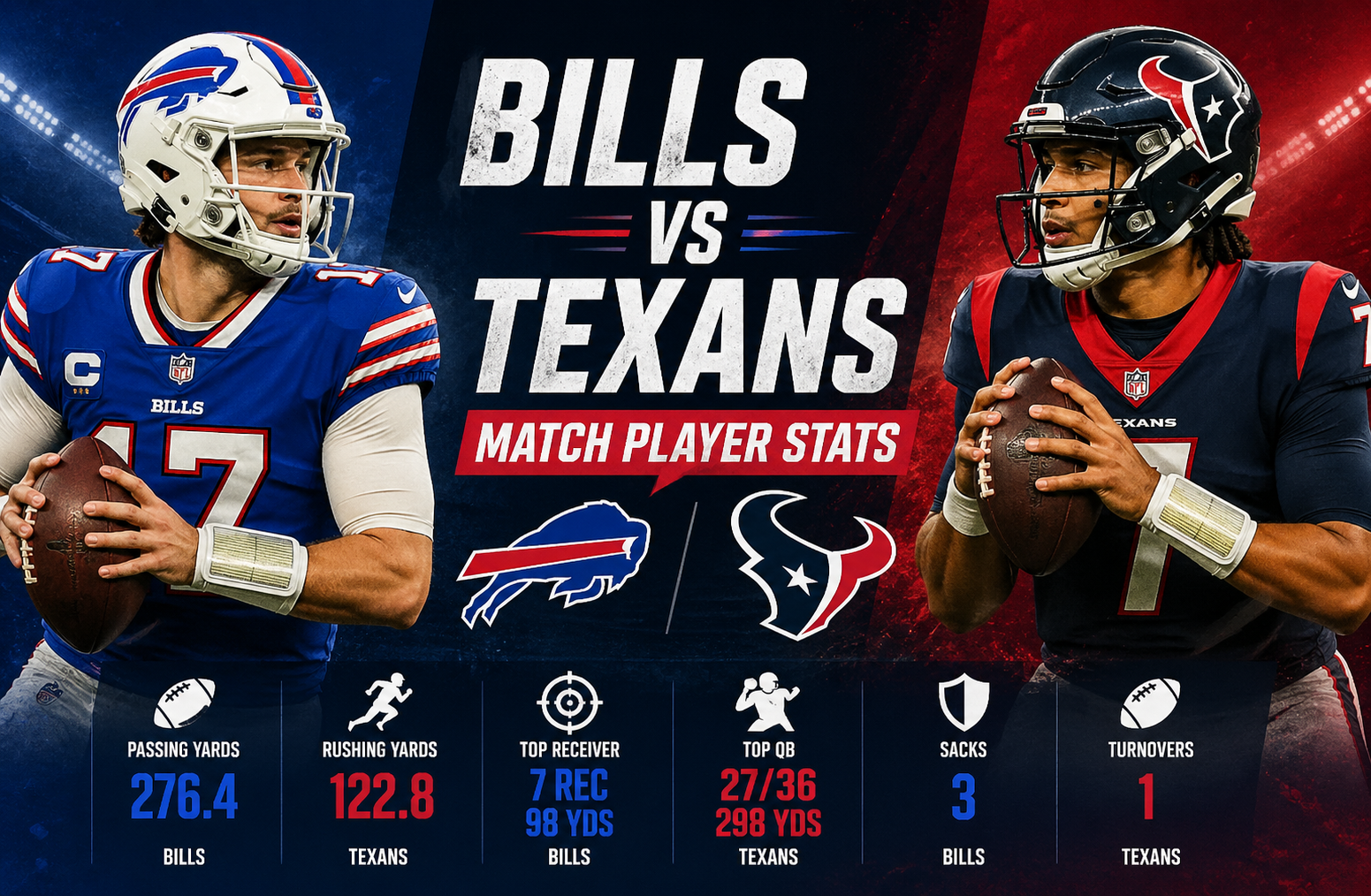
Buffalo Bills vs Houston Texans Match Player Stats
The Buffalo Bills vs Houston Texans Match Player Stats search intent usually comes from fans who want more than a final score. They want to know who controlled the game, which players changed momentum, how quarterbacks performed under pressure, and what the numbers say about team strengths. This article breaks down the matchup in a practical, easy-to-read way so you can understand performance trends, player impact, and what the stats really mean.
When the Buffalo Bills and Houston Texans meet, the game often features contrasting styles. Buffalo has frequently leaned on explosive quarterback play, vertical passing, and defensive pressure. Houston has often relied on balance, speed, and young talent development. That contrast makes player stats especially valuable because raw numbers reveal where the game was won.
Many box scores only show passing yards, rushing yards, and touchdowns. Real insight comes from deeper context such as completion efficiency, third-down success, red-zone production, sacks allowed, missed tackles, and turnover margin.
This guide explains all of that in a people-first format built for readers who want clear answers.
Buffalo Bills vs Houston Texans Match Player Stats Breakdown
To properly understand the Buffalo Bills vs Houston Texans Match Player Stats, it helps to divide the matchup into six performance zones:
- Quarterback production
- Running back efficiency
- Wide receiver impact
- Defensive disruption
- Special teams value
- Situational football performance
Each category can decide the result.
Quarterback Performance Analysis
Quarterback stats usually shape the story first.
Buffalo Bills Quarterback Metrics
Buffalo has often depended on elite quarterback creation. In matchups like this, the most important numbers include:
- Completion percentage above 65%
- Yards per attempt above 7.5
- Touchdown to interception ratio
- Third-down conversions through passing
- Red-zone touchdown rate
If Buffalo’s quarterback adds rushing yards, the pressure on Houston’s defense increases dramatically.
Houston Texans Quarterback Metrics
Houston’s quarterback success is often tied to rhythm and decision-making.
Important indicators:
- Fast release time
- Limited sacks taken
- Accuracy on short and intermediate throws
- Play-action success
- Protecting the football
When Houston avoids turnovers, they usually stay competitive longer.
What the Numbers Usually Mean
If one quarterback throws for 280+ yards with 2 touchdowns and no turnovers while the other faces constant pressure, the game often swings clearly in one direction.
Running Back and Ground Game Stats
Many fans ignore rushing stats unless a player crosses 100 yards. That is a mistake.
A back with 72 yards on 14 carries can be more impactful than a back with 95 yards on 28 carries because efficiency matters.
Buffalo Bills Ground Attack
Buffalo’s run game often works best when it creates:
- 4.5+ yards per carry
- Short-yardage conversions
- Play-action support
- Clock control in second half
Quarterback scrambling can also inflate total rushing numbers and stress defenders.
Houston Texans Ground Attack
Houston’s rushing identity often focuses on patience and balance.
Key numbers:
- Early-down rushing success
- Explosive runs of 10+ yards
- Red-zone rushing touchdowns
- Ball security
When Houston reaches 120+ total rushing yards, their offense becomes harder to defend.
Wide Receivers and Tight Ends
Receiver stats tell you who created separation and who moved chains.
Buffalo Bills Receiving Leaders
Buffalo typically gains the most value when top targets produce:
- 7+ receptions
- 90+ yards
- Third-down catches
- Red-zone touchdowns
- Yards after catch
A star receiver forcing double coverage also helps secondary targets.
Houston Texans Receiving Leaders
Houston often uses speed and route variety. Productive receiver games may look like:
- Balanced targets across 4 or 5 players
- Explosive sideline catches
- Screen-game efficiency
- Slot production on third down
Balanced distribution is often a sign of quarterback comfort.
Defensive Player Stats That Matter Most
Defense can be hidden in standard box scores. These numbers matter more than many realize.
Pressure and Sack Rate
Quarterbacks under pressure lose efficiency quickly.
Important stats:
- Sacks
- QB hits
- Hurries
- Forced throwaways
If Buffalo records 4 sacks, Houston likely struggled in protection. If Houston creates pressure without blitzing, Buffalo’s offense can slow down.
Tackles for Loss
These kill drives by putting offenses behind schedule.
Interceptions and Forced Fumbles
Turnovers often decide NFL games faster than yardage totals.
A team can lose total yards and still win through takeaway margin.
Red-Zone Defense
Allowing field goals instead of touchdowns changes everything.
Offensive Line Performance
Offensive line stats are often overlooked, but I’ve found they explain many surprising results.
Watch these areas:
- Sacks allowed
- Pressures allowed
- Penalties
- Run-block success
- Goal-line push
If a line allows repeated interior pressure, the quarterback’s stats usually decline immediately.
Third Down and Situational Football
This is where smart teams separate themselves.
Third-Down Conversion Rate
A team converting 8 of 13 third downs controls tempo.
Time of Possession
Long drives can protect a defense and wear down pass rushers.
Two-Minute Efficiency
End-of-half scoring chances are high leverage moments.
Red-Zone Execution
Touchdowns matter more than field goals.
Example Stat Line Interpretation
Imagine these simplified numbers:
Buffalo
- 365 total yards
- 27 first downs
- 2 turnovers forced
- 8 of 13 third downs
- 31 points
Houston
- 318 total yards
- 19 first downs
- 1 turnover lost
- 5 of 12 third downs
- 20 points
This likely suggests Buffalo sustained drives better, created extra possessions, and finished more efficiently.
Player Matchups That Often Decide the Game
Bills Edge Rusher vs Texans Offensive Tackle
If the pass rusher wins repeatedly, Houston’s passing rhythm breaks.
Texans Cornerback vs Bills WR1
If Houston limits explosive catches, Buffalo may need longer drives.
Texans RB vs Bills Linebackers
Missed tackles here can flip field position quickly.
Bills Tight End vs Texans Safeties
Middle-of-field success often becomes a hidden advantage.
Advanced Stats Worth Following
Modern football analysis goes beyond traditional totals.
EPA Per Play
Expected Points Added measures how much each play improves scoring chances.
Success Rate
Shows consistency, not just explosive moments.
Yards After Catch
Great indicator of receiver separation and scheme design.
Pressure Rate
Better than sack totals alone because pressure can disrupt even without sacks.
For deeper NFL statistical methods, readers can explore official data resources at the NFL Stats Center.
Common Reasons Stats Mislead Fans
Empty Yardage
Some passing yards come late when defenses protect a lead.
One Big Play Distortion
A single 70-yard touchdown can inflate averages.
Turnover Luck
A tipped interception may not reflect overall quarterback quality.
Penalty Impact
A holding call can erase a strong play and shift a drive.
Real-World Viewing Insight
When I review matchups like this, I focus less on total yards and more on sequence control:
- Who wins first down
- Who avoids negative plays
- Who scores touchdowns in red zone
- Who handles pressure late
Those four factors often explain the final result better than raw yardage.
How Bettors, Fantasy Players, and Fans Use These Stats
Fantasy Football
- Target volume for receivers
- Red-zone carries for backs
- QB rushing upside
Betting Analysis
- Sack mismatches
- Injury-related depth issues
- Pace and possession trends
Fans and Analysts
- Growth of young players
- Coaching adjustments
- Efficiency under pressure
Frequently Asked Questions
1. Why are player stats important in Bills vs Texans games?
They reveal who truly influenced the result beyond the final score.
2. Which stats matter most for quarterbacks?
Completion rate, yards per attempt, touchdowns, turnovers, and pressure response.
3. Are rushing yards enough to judge running backs?
No. Efficiency, broken tackles, and short-yardage success matter too.
4. What defensive stats are most valuable?
Sacks, pressures, takeaways, tackles for loss, and red-zone stops.
5. Can a team win with fewer total yards?
Yes. Turnovers, field position, and red-zone efficiency often outweigh yardage.
6. How should fans read Buffalo Bills vs Houston Texans Match Player Stats?
Use context. Look at efficiency and key moments, not just totals.
Conclusion
The Buffalo Bills vs Houston Texans Match Player Stats story is rarely told by one number. Quarterback decisions, rushing efficiency, pass protection, defensive pressure, and red-zone execution all shape outcomes. Smart analysis means understanding how stats connect to game flow rather than reading a box score in isolation. When you study the matchup this way, you gain a clearer view of why teams win and which players truly drive results.