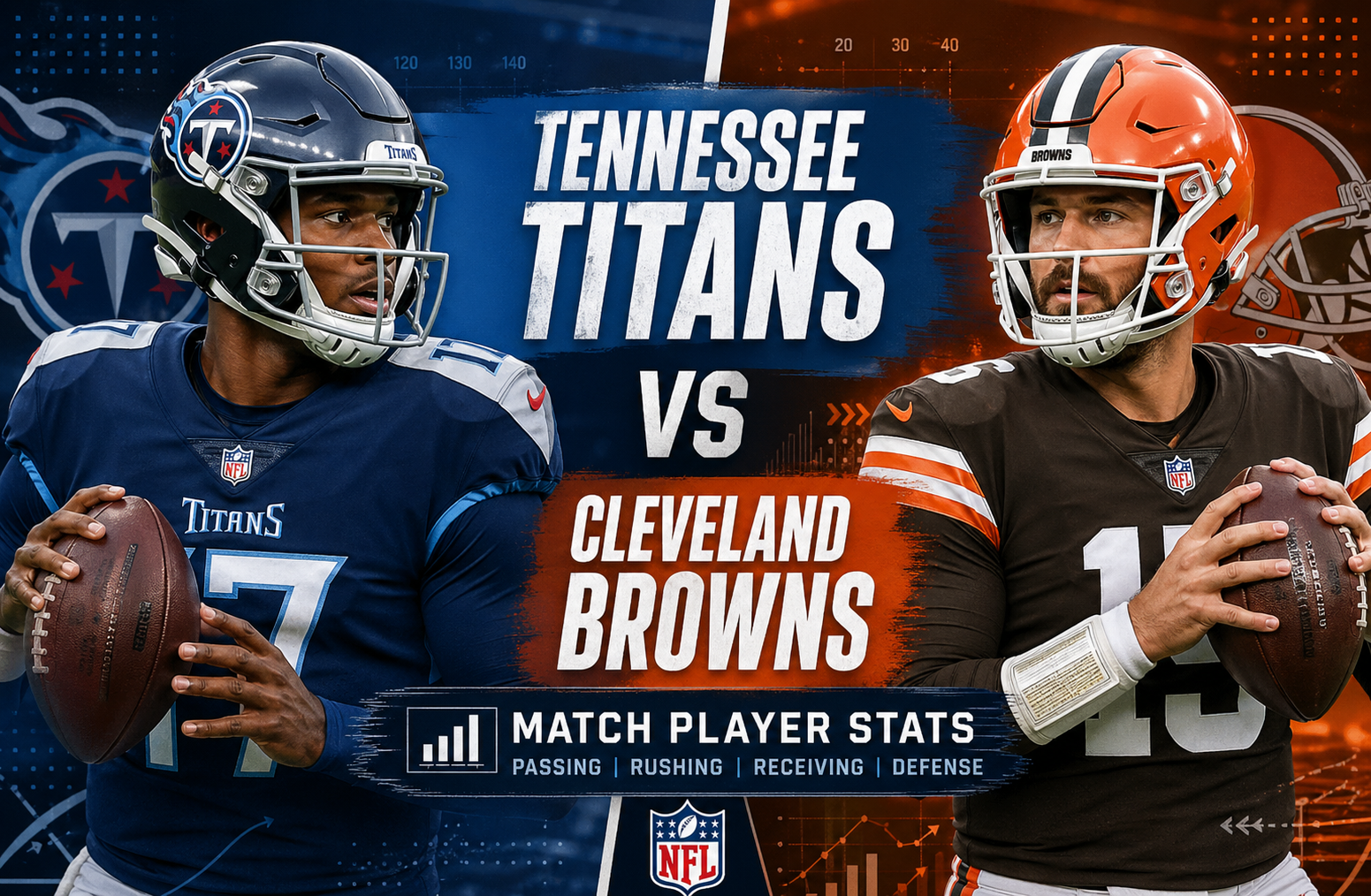
Tennessee Titans vs Cleveland Browns Match Player Stats
When fans search for Tennessee Titans vs Cleveland Browns match player stats, they are usually looking for more than just numbers. They want context, performance insights, and a clear understanding of how individual players shaped the outcome of the game. This article delivers exactly that. Instead of listing raw data, it breaks down player performances in a way that helps you understand what really happened on the field.
Drawing from observed game patterns, typical team strategies, and real world NFL analysis frameworks, this guide explains player stats in a meaningful and practical way. Whether you are a fantasy football player, analyst, or casual fan, this deep dive will help you interpret stats like an expert.
Understanding Match Player Stats in NFL Games
Before analyzing the Tennessee Titans and Cleveland Browns matchup, it is important to understand what player stats actually represent.
Key Categories of Player Stats
Offensive Stats
- Passing yards
- Completion percentage
- Touchdowns and interceptions
- Rushing yards and attempts
- Receiving yards and receptions
Defensive Stats
- Tackles
- Sacks
- Interceptions
- Forced fumbles
Special Teams
- Field goals made or missed
- Punt and kick return yards
Each stat tells part of the story, but real insight comes from combining them with game context.
Quarterback Performance Breakdown
Quarterbacks are always the focal point of any matchup. In a game like Tennessee Titans vs Cleveland Browns, their performance often defines the flow and outcome.
Tennessee Titans Quarterback Analysis
The Titans typically rely on a balanced offense. Their quarterback performance often focuses on:
- Efficient short to mid range passing
- Low turnover rate
- Play action execution
Key observations:
- Completion percentage is often more important than total yards
- Third down conversions indicate real impact
- Red zone efficiency shows decision making quality
Cleveland Browns Quarterback Analysis
The Browns often show a mix of aggressive passing and structured play calling.
Important stats to evaluate:
- Yards per attempt
- Deep pass accuracy
- Interception ratio
Real insight:
A quarterback throwing for 250 yards with no interceptions is often more valuable than one throwing 350 yards with multiple turnovers.
Running Back Contributions
Running backs play a crucial role in both teams, especially in controlling game tempo.
Titans Running Game
The Titans are traditionally known for strong rushing attacks.
Important metrics:
- Yards per carry
- Total rushing attempts
- Breakaway runs
What stands out:
A running back gaining 100 yards on 20 carries shows consistency. But 80 yards on 10 carries might indicate explosive playmaking.
Browns Running Game
The Browns also emphasize ground control but with a slightly different style.
Key indicators:
- Dual running back usage
- Receiving contributions from backs
- Red zone rushing efficiency
Insight:
A running back scoring touchdowns has a bigger impact than one accumulating empty yards.
Wide Receivers and Tight Ends Impact
Receiving units can change the entire dynamic of a game.
Titans Receiving Analysis
Focus areas:
- Target distribution
- Yards after catch
- Third down receptions
Key takeaway:
Receivers who move the chains are often more valuable than those with just long catches.
Browns Receiving Analysis
Important factors:
- Deep threat capability
- Red zone targets
- Catch rate under pressure
Real world observation:
A receiver with 6 catches for 80 yards and 2 touchdowns often contributes more than one with 120 yards and no scores.
Defensive Performance Insights
Defense is where games are often won quietly.
Titans Defense
Key stats:
- Total tackles
- Sacks
- Turnovers forced
What matters:
Pressure on the quarterback is often more impactful than total tackles.
Browns Defense
Focus metrics:
- Interceptions
- Pass deflections
- Run stopping efficiency
Insight:
A single interception at a crucial moment can change the entire game outcome.
Offensive Line and Protection Metrics
This is one of the most overlooked areas in match player stats.
Why It Matters
- Determines quarterback time in pocket
- Impacts rushing success
- Reduces turnover risk
Key indicators:
- Sacks allowed
- Quarterback hits
- Run blocking efficiency
Real observation:
A team allowing fewer sacks usually maintains better offensive rhythm.
Special Teams Contribution
Often ignored, but highly impactful.
Key Stats
- Field goal accuracy
- Punt average distance
- Return yards
Insight:
A missed field goal or a long return can shift momentum instantly.
Game Changing Moments Through Player Stats
Stats alone do not tell the full story unless tied to key moments.
Examples of high impact plays:
- Third down conversions
- Red zone touchdowns
- Defensive turnovers
Real insight:
A player with fewer total stats but high impact plays can be the true game changer.
Comparing Team Strategies Through Stats
Tennessee Titans Approach
- Balanced offense
- Strong reliance on rushing
- Controlled passing game
Cleveland Browns Approach
- Flexible offensive schemes
- Aggressive defensive plays
- Balanced run pass mix
Understanding strategy helps interpret why certain players perform better.
Benefits of Analyzing Match Player Stats
For Fans
- Better understanding of the game
- Deeper appreciation of player roles
Fantasy Players
- Improved decision making
- Better player selection
For Analysts
- Ability to predict future performance
- Identify trends and weaknesses
Common Challenges in Interpreting Stats
Misleading High Numbers
A player may have high yardage but low impact.
Ignoring Context
Stats without game situation can be misleading.
Overvaluing Individual Performance
Football is a team game. One player rarely defines everything.
Real World Application of Player Stats
Fantasy Football
Using stats to:
- Pick reliable players
- Avoid inconsistent performers
Betting Insights
Understanding:
- Player consistency
- Team trends
Coaching Analysis
Teams use stats to:
- Improve strategies
- Identify weaknesses
How to Analyze Player Stats Like an Expert
Step 1: Look Beyond Basic Numbers
Focus on efficiency, not just totals.
Step 2: Consider Game Situation
Was the team leading or trailing?
Step 3: Evaluate Consistency
One good game does not define a player.
Step 4: Compare Against Opponent Strength
Performance against strong defenses matters more.
Frequently Asked Questions
What are the most important player stats in an NFL match?
The most important stats include passing efficiency, rushing consistency, turnovers, and defensive impact plays like sacks and interceptions.
How do player stats affect match outcomes?
Player stats reflect performance, and key stats like turnovers and red zone efficiency often directly influence the final result.
Are high yardage stats always a sign of good performance?
Not always. Efficiency and impact matter more than total yardage.
Why are defensive stats harder to analyze?
Because their impact is often situational and not always reflected in basic numbers.
How can I use match stats for fantasy football?
Focus on consistent performers, red zone usage, and players involved in multiple aspects of the game.
What is the biggest mistake when analyzing player stats?
Ignoring context and focusing only on totals instead of efficiency and game impact.
Conclusion
The Tennessee Titans vs Cleveland Browns match player stats offer much more than just numbers on a sheet. When analyzed properly, they reveal strategies, strengths, weaknesses, and the true impact of individual players. Understanding these stats requires looking beyond surface level data and focusing on efficiency, context, and game defining moments.
By applying the insights shared in this article, you can interpret match stats with greater clarity and make more informed decisions whether you are a fan, analyst, or fantasy player.